

The word cemetery comes from the Greek koimeterion, a "sleeping place" or dormitory. Early Christian writers gave that name to burial grounds, as if the dead were only waiting to wake up. I find that fitting for a dream: you were asleep, and your sleep led you to another place of sleep. Here's how to read what you saw there, without hunting for omens, and gently if this dream touched a recent loss.
Does dreaming of a cemetery mean someone is going to die?
No. Nothing about this dream lets you read it as a prediction of a death, yours or anyone else's.
Waking up scared makes sense: the setting is built to scare you. But a cemetery is first of all where we put what's finished, and where we come back to remember it. Dreams often use it that way: a relationship that ended, a job you left, a stretch of life that won't come back, a version of you that you've outgrown. Sometimes, of course, it's about someone who has died. Even then, the dream is about memory, and nothing in it is a forecast.
Two questions go a long way in figuring out what yours is about. Did you know this cemetery, or the names on the stones? And what did you feel while you were there: fear, sadness, an unexpected calm? An unfamiliar cemetery you pass through without much feeling points mostly to something ending inside you. A familiar one, with a name you recognize, points to a bond with someone. If death itself keeps showing up in your dreams, dreaming of death picks up where this leaves off.
What does it mean to walk through a cemetery in a dream?
Walking among graves usually means you're going over something that has ended. Your pace, and whether you stop or not, show where you are with it.
This is one of the most common versions of the dream, and I can see why it lingers: almost nothing happens, yet you wake up shaken. Picture yourself moving slowly, reading a name here and there, in no hurry. That rhythm is the rhythm of taking stock: you're revisiting memories without getting lost in them. A fast walk with your eyes on the ground looks more like what we do around a subject we'd rather avoid.
Cutting through a cemetery to get to the other side isn't the same as wandering in it. In the first case, the ending the dream is about is a passage: you come out the other side, and life goes on past the gate. In the second, you're taking your time, and there's probably something you need to look at again before you move on.
Notice whether you were alone, too. Walking with someone among the graves often shows you're not going through this stretch without support, even if the person in the dream isn't the one actually helping you.
What are you looking for when you can't find a grave?
Most often, a goodbye that never happened. Searching for one specific grave and reading only the wrong names suggests a loss you can't quite locate yet.
This is a hard dream, and I want to handle it with care. When the grave you're looking for belongs to someone who really died, the dream often replays what was missing: a funeral you couldn't make it to, an illness that left little time, words that were never said. It's looking for somewhere to set that grief down. Dreaming of a deceased parent covers the dreams where the person comes back themselves.
If nobody from your life is buried there, the missing grave may point to something else: a friendship that faded without a fight, a project you quietly dropped, a town you moved away from. Anything that stopped without your getting to mark it in some way.
And if you find the grave at the end of the dream? I read that as relief. You now know where the thing you lost is, and you can stay there for a moment.
Why is the cemetery in your dream dark?
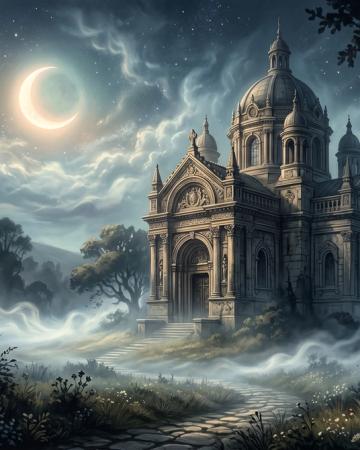
Night adds uncertainty: you can barely see, and you hear everything. This dream often points to an ending whose shape you can't quite make out yet.
I don't read this setting as a threat. It suggests you're at the start of the road: what ended is still blurry, and you don't fully know what you've lost or what comes next. What matters is how you reacted in the dream. If you moved through it afraid, looking for the way out, this ending probably worries you more than it saddens you right now. If you felt oddly calm, like someone who knows the place, part of you has already accepted what's changing.
There's also a detail I like. A cemetery at night is the "dormitory" in the dark, the sleeping place at sleeping time. If your dream left you feeling rested rather than anxious, don't force it to be grim. It may simply be showing you things that are asleep, and that can be left to sleep.
What does it mean to dream of the cemetery where your family is buried?
It's almost always about them, and about the place they still hold in your life. It's often a grief dream, recent or old.
When the place is real, when you recognize the path and the stone, the dream takes you back to one particular person. It can go along with grief that's running its course: you go back to visit, the way people do in waking life. It can also come when you haven't been in a long time and the urge, or some guilt, is working on you. I don't believe the person who died is reproaching you there. The question comes from you, and it deserves to be heard without harshness.
Some dreams widen the scene to the whole family: grandparents' graves, great-grandparents whose first names you barely know. These are about belonging, about what you were handed without choosing it. Dreaming of ancestors goes further into that tie with the generations before you.
If this dream keeps coming back since a loss, and the sadness doesn't ease over the weeks, reach out to a friend or family member, or to a grief counselor: grief is easier to carry with company. To see how mourning shows up at night as well, you can read dreaming of mourning.
What if you don't know anyone in the cemetery?
Then the dream is probably about you: what you've left behind, the roles, habits, or plans that have come to an end.
A cemetery of strangers, with names you can't read, is like a storehouse of finished things. You'd find who you were at twenty in there, the ambitions you let go of, ways of doing things that don't fit you anymore. The dream shows them put away, each in its place. They're not chasing you.
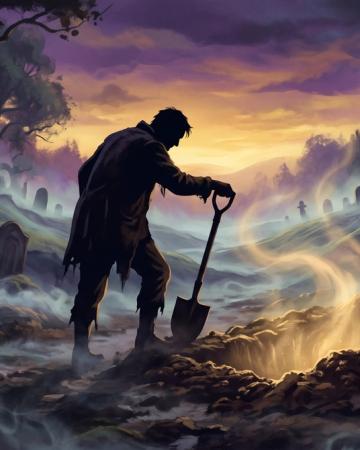
What changes the reading is what you do there. If you're digging, or helping someone prepare a grave, you're actively burying something: you're no longer just going through an ending, you're handling it. The figure of the gravedigger has its own page for that reason. If you're only looking, you're more in the taking-stock phase, which is often what comes before space opens up for something new.
I'll admit this version sometimes leaves me without a clear answer. A cemetery with no faces can also reflect a vague anxiety with no clear object, one that mostly needs a name. When in doubt, ask yourself what has ended in your life over the past few months, even quietly.
Why does this dream come back around anniversaries and certain holidays?
Because the calendar brings the people you've lost back into your thoughts, and dreams pick up whatever fills your days.
Memorial Day, the anniversary of a death, a birthday, a holiday table with an empty chair: any of these can bring the dead to mind. In early November, All Souls' Day and the Day of the Dead (Día de Muertos) are when many families visit and decorate graves. Even if you don't, a conversation or an old photo resurfacing is enough to stir memories. A cemetery dream at times like these isn't strange at all. It's following your memory, not warning you of anything.
If it weighs on you, you can answer it with something real: stopping by a grave, lighting a candle at home, looking at a photo and taking your time with it. A dream like this one usually asks for a little attention, rarely more.
One thing to do this morning: if a name carved in stone stuck with you, write it down, even if it means nothing to you. Next to it, note what you were doing in the dream: walking, searching, stopping, running. Those two lines are often enough to show what the cemetery was about. The Midnight Mind app keeps your dreams dated, so the day this one comes back, you can put the two versions side by side and see what has shifted.