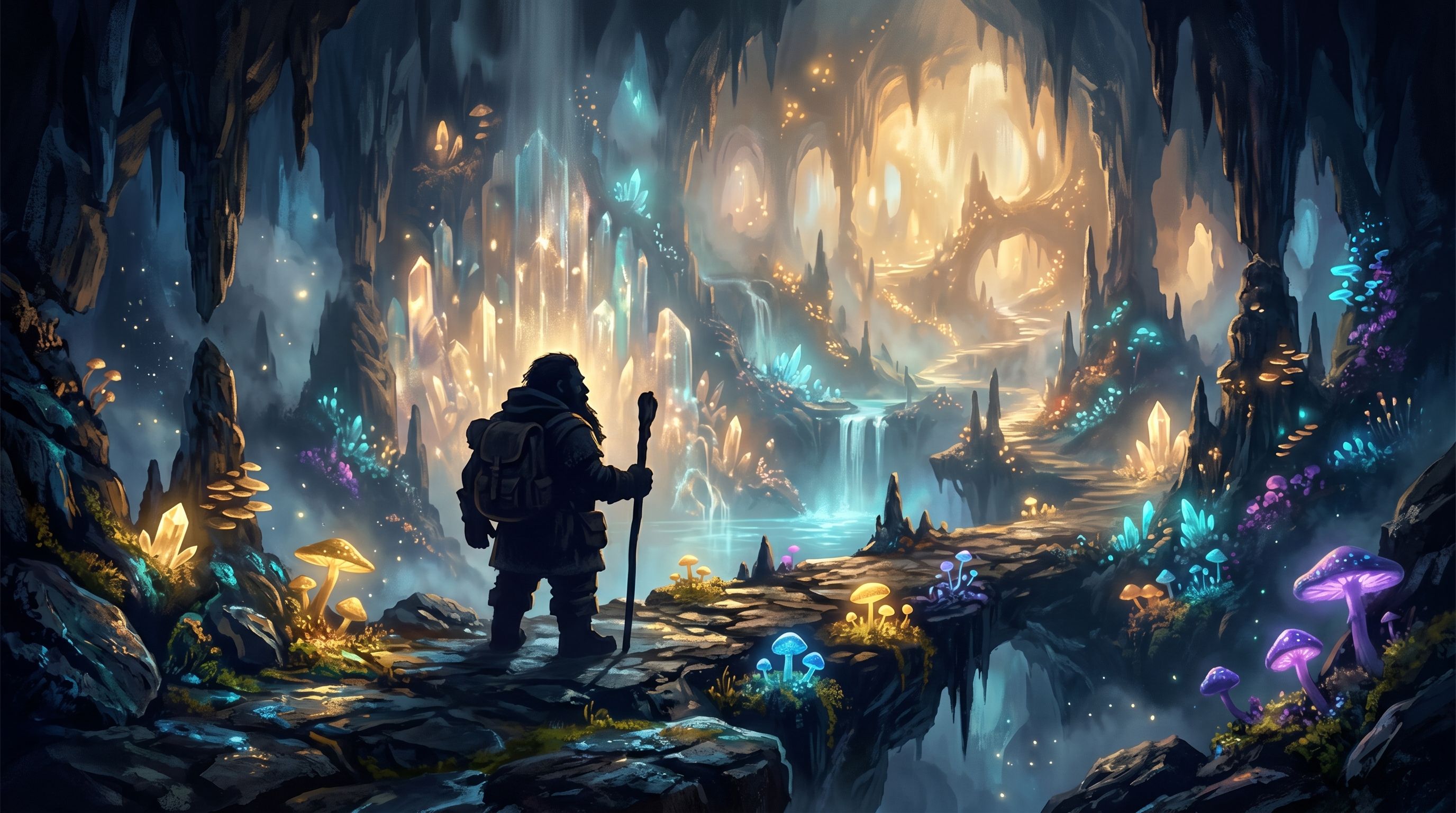
The Womb of the Earth: Why Your Unconscious Leads You to the Hollow of the Rock
I find that the cave is one of the most misunderstood symbols in traditional dream dictionaries. They will often tell you it’s a sign of withdrawal, sadness, or fear of the future.
What a limited vision! For someone like me, who has traveled through your dreams for centuries, the cave is, above all, a promise.
When you dream of descending deep into the earth, your unconscious isn't trying to bury you alive. It is inviting you into a "reset chamber."
In the total darkness of a cavern, your usual senses become useless. You are forced to rely on your intuition and on your feelings.
By placing you in this visual void, your mind offers itself a break from the clamor of the outside world. It allows you to focus on the essential: your deepest self.
I often see dreamers worry about how narrow the walls feel. Yet, if you think about it gently, isn't that the ultimate feeling of security?
It is the feeling of a child before birth. If you feel peaceful in this dream cave, perhaps your current life is too exposed, too noisy.
Your soul is calling for a sanctuary—a place where no one can reach you. It is a place where you can finally be "nothing" so that you can become "everything" once more.
---
Facing the Darkness: When the Cavern Becomes a Mirror for Your Fears
Sometimes, the cave is frightening. We fear getting stuck or crossing paths with a forgotten creature.
Honestly, I understand that anxiety. Darkness is the breeding ground for all our projections.
But the cave does not create the monster; it merely contains it so that you can observe it at your own pace. If the cave in your dream feels dark and oppressive, it’s because you are touching what psychologists call "the Shadow."
These are the parts of yourself—your anger, your unconfessed desires, your stifled talents—that you have relegated to the basement. The cavern is their home.
To enter it takes immense courage. It is saying: "I am ready to see what is hiding beneath the surface."
🌙 Yume’s Echo: Sometimes, the darkness isn't there to hide things from you, but to allow your own inner light to finally become visible.
I sometimes encounter dreamers who confuse a cave with a passage. There is a subtle nuance here.
If you feel you are simply passing through a narrow space to get from point A to point B, you are experiencing a transition. A cave, however, is a place to stay.
You don't just pass through; you remain there for the duration of a metamorphosis. It is a circular, organic space that requires stillness rather than speed.
I remember a dreamer who told me she was trapped in a crystal cavern. She was terrified of breaking the walls.
By talking with her through the threads of her dreams, she realized those crystals were her own barriers of perfectionism. The cave wasn't her enemy; it was simply showing her the beauty—and the fragility—of the prison she had built for herself.
---
The Science of the Subterranean: What Research Suggests
While the mystical interpretation is rich, science also offers us fascinating perspectives on why our brains choose such ancient imagery. Some specialists in evolutionary psychology suggest that dreaming of caves may be linked to "Threat Simulation Theory."
This theory, notably discussed by Antti Revonsuo (2000), suggests that our dreams serve as a biological defense mechanism. They allow us to practice navigating dangerous or confined environments in a safe state.
Furthermore, the brain's activity during REM sleep—the stage where most vivid dreams occur—shows a high level of activation in the amygdala. This is the part of your brain responsible for processing emotions, especially fear.
When you dream of a cave, your brain might be attempting to "spatialise" a complex emotion. It turns a vague feeling of being trapped into a physical landscape you can navigate.
Some researchers also believe that the "coolness" or "dampness" you feel in a cave dream might be a literal interpretation of your sleeping environment. Your brain takes a slight drop in body temperature or a draft in your room and weaves it into a subterranean narrative.
---
The Treasure or the Spring: What You Find at the End of the Hallway
What lies at the bottom of your cave? That is often where the key to the dream resides.
Some find a spring of crystal-clear water. In dream language, water in a cave represents pure emotion—that which hasn't yet been polluted by social judgment.
It is an announcement of healing. Others see cave paintings, ancient symbols that seem to speak to them personally.
This is your heritage, your ancestral wisdom rising to the surface. It is a moment of profound connection to the human collective.
But be careful—I’m not a fan of "cookie-cutter" interpretations. The cave is a place of raw truth.
If you find a Crown hidden in the mud, it suggests a hidden sense of self-worth that you haven't yet claimed. It is a sovereignty that exists even when no one is watching.
Conversely, if you feel overwhelmed by the "choices" of paths within the cave, it might mirror the modern anxiety of a Supermarket, but stripped down to its primal essence. Where the supermarket is about external consumption, the cave is about internal direction.
---
Concrete Example: The Architect’s Grotto
To help you understand how this manifests, let's look at a common use case. Imagine a professional who feels "burnt out" and dreams of being lost in a cave with no exit.
In this scenario, the cave isn't a warning of failure. Instead, it represents the dreamer's need to stop "building" and start "being."
The lack of an exit in the dream isn't a trap; it's an invitation to sit down. Once the dreamer in our example stopped trying to find the way out and simply looked at the walls, they noticed the walls were made of gold.
This shift in perspective—from escaping the darkness to valuing the space—is the goal of the cave dream. It asks you to stop running and start observing.
---
How to Honor Your Cave Dream
My advice, if you have just returned from such a dream, is not to analyze it with cold logic. Stay for a moment in the atmosphere of that darkness.
Was it protective like velvet or cold like granite? Your bodily sensation is your best compass.
The cave asks you to become a little more "animal," to trust your gut rather than your head. Here are a few rituals to help you integrate the experience:
- The Sensory Recall: Sit in a dark room for five minutes and try to recreate the "scent" of the cave from your dream.
- The Earth Connection: If possible, spend time near large rocks or even in a basement. Feel the weight of the earth above or around you.
- The Journaling Seed: Write down one thing you are currently "gestating"—an idea, a change, or a feeling that isn't ready for the light yet.
Dreams are not threats; they are hands reaching out from the depths of your unconscious to help you find your own balance. The cave is there to remind you that even in the most complete darkness, you are home.
If you want to explore your dreams more deeply and keep a record of these subterranean explorations, your Baku is waiting for you. Every cave you visit is one more room in the great palace of your consciousness. Which one will be next? 🔮
Have you noticed how quiet it is down there? Not a dead silence, but a heavy, breathing silence where every drop of water hitting the stone sounds like a heartbeat. It reminds me of ancient vision quests where seekers would deliberately isolate themselves in the dark to receive guidance. Unlike those who seek the airy, dusty heights of retreating to an attic to organize their conscious memories, the cave forces you down into your body, into the damp, heavy weight of gravity. It is a deeply physical experience. I sometimes think our modern allergy to stillness is why the cave feels so terrifying to some. You cannot run there; you can only crawl, feel the cold stone against your palms, and listen to the patient rhythm of the earth. It is a reminder that your healing cannot be rushed, requiring the quiet dark to take root.