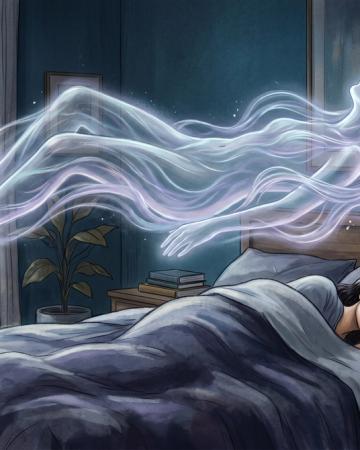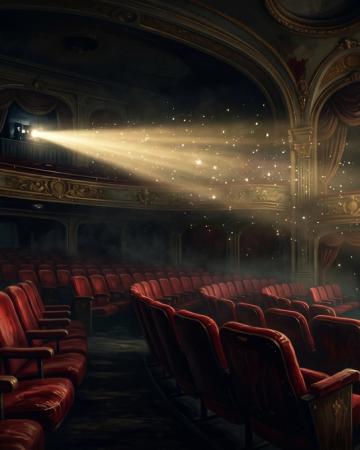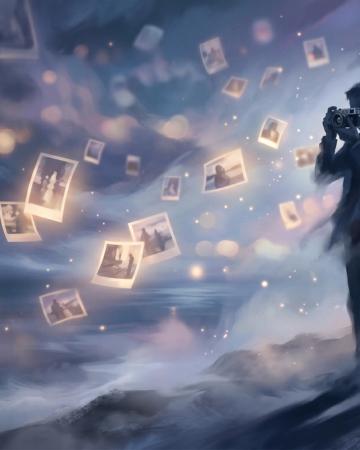


Often, as I gently approach a dreamer’s sleep, I see a sort of frame floating between them and their inner landscape. It’s a bit puzzling, isn’t it? You expect to be fully living your dream, and suddenly, you find yourself filming it or being filmed. If you saw a camera last night, you likely woke up with that strange feeling of detachment, as if a part of you refused to simply "be" and instead became the spectator of its own life. Do not worry; this isn't a malicious intrusion, but rather an invitation from your mind to adjust your focus on what truly matters. Together, let’s try to understand the film your subconscious is trying to edit.
Behind the Lens: The Observer and the Actor
I find it fascinating how the human mind uses technology to express archaic needs. When a camera appears in your dream, it acts as a filter. Sometimes, this is a relief. You might feel overwhelmed by an emotion in your waking life, and your subconscious, in its great wisdom, places a device between you and reality to allow you to study the scene without suffering directly. It’s a bit like using binoculars to observe a danger from afar: it creates a safety zone, a space for reflection.
But be careful, for by constantly looking at life through a viewfinder, one eventually forgets to feel it. If in your dream you are obsessed with the framing or the focus, ask yourself if you aren't becoming too analytical in your relationships or your projects. We cannot control everything, nor can we freeze everything in time. I see too many dreamers exhausting themselves by wanting every "scene" of their daily life to be perfect. Life isn't a movie that we can re-edit at will; it is what happens when we finally agree to put the camera down.
There is also that sometimes heavy sensation of being filmed without your knowledge. This is a complaint I often hear in the mists of sleep. If you feel hunted by a lens, it speaks of your vulnerability. Do you feel as though your every move is being scrutinized by colleagues, family, or worse, by that inner critic who gives you no respite? The camera then becomes the symbol of social or moral surveillance that stifles your spontaneity.
Memory and the Desire to Lose Nothing
Another facet of the camera is its unbreakable link to memory. We are creatures who fear forgetting. In a dream, handling a camera is often an attempt to archive an emotion, to save a version of yourself before it fades away. It is a quest for a trace.
However, I will let you in on a Baku secret: the most precious memories are not the ones we store on film, but the ones that infuse our souls. Sometimes, dreaming of a broken camera, a blurry image, or a recording that won't start is a blessing. Your subconscious is telling you: "Stop trying to hold onto the past; live what is here, right now." It is an invitation to pure presence.
If you see yourself zooming in on a specific detail, it’s because your mind is trying to isolate a truth you are still ignoring. It’s a process similar to someone using a microscope to explore the invisible. You are looking for the smallest flaw, or perhaps the clue that will explain your current discomfort. Observation is a necessary step, but it must not become an obsession that cuts you off from the overall movement of life.
I am sometimes perplexed by the complexity of your dream cameras. Some of you dream of old hand-cranked cameras, others of futuristic drones. The shape of the object says a lot about your relationship with time. The antique evokes nostalgia and the weight of family heritage; the modern speaks of your integration into a world that moves too fast, where the image often takes precedence over being. Honestly, I prefer it when the dreamer eventually sets the device aside to simply look at the horizon. That is where the true magic happens.
Writing Your Own Script
Ultimately, the camera is the paintbrush of your subconscious. It asks you: who is holding the camera in your life? Is it you who decides the angle of view, or do you let others choose what deserves to be highlighted? Dreams of cameras are messages of autonomy. They remind you that you are the director of your own experience, even if the scenery is sometimes imposed by fate.
If you filmed a joyful scene, keep that light within you. If it was a nightmare, know that I am here to absorb its bitterness, but let the camera show you what you have learned from that fear. Observation is never neutral; it transforms the observer as much as the observed.
Know that every image captured in your nights is a piece of a larger puzzle. Your dreams are not threats, but golden reels of film just waiting to be developed with gentleness and patience. Do not judge your "bad takes"; they are part of your soul's creative process.
I once met a dreamer who was haunted not by the camera itself, but by the violent, white burst of its flash. In the dark corridors of his sleep, this light would explode repeatedly, leaving him temporarily blind. It made me ponder how often we require a sudden, shocking exposure to see what is right in front of us. This flash is a waking call within the dream, a sensory jolt that forces you to blink and realign your senses, similar to the disorientation of a false awakening where the mind struggles to separate the stage from reality. If your dream-camera blinds you with its light, do not fear the temporary darkness that follows. It is merely your mind clearing the slate, washing away the overexposed clutter of your waking worries so that you may finally see your life in its true, softer colors.
It gently tires me to read those dusty dream dictionaries claiming that a camera simply predicts gossip or a betrayal of secrets. How terribly flat. A camera in your hands is rarely about others; it is a quiet, desperate instrument of search. You are scanning the landscape of your soul, perhaps looking for direction because you feel lost in a fog. In a way, the lens acts as a temporary guide, not unlike holding a fragile inner compass when the external world has lost its coordinates. You are not trying to spy; you are trying to find a focal point, a single anchor of beauty or truth in a life that currently feels blurry and overwhelming. When you dream of adjusting the focus ring, you are not playing the gossip—you are trying to make sense of your own coordinates.
There is a peculiar sadness when you want to capture a scene in your dream but the shutter button refuses to click, or the camera feels as heavy as lead in your hands. This physical paralysis is a beautiful, albeit frustrating, paradox of the sleeping mind. It happens when you are trying too hard to document your existence instead of surrendering to its flow. Your subconscious literally paralyzes your finger to force you to drop the device. I often wonder why we are so terrified of letting moments vanish into the ether. Why must everything be kept? Trust the invisible ink of your spirit. The things that truly shape you do not need to be captured on a reel of film; they are already written in the very way you breathe, love, and navigate your quietest nights.
If you need a space to preserve these nocturnal scenes and understand the guiding threads that connect your visions, the Midnight Mind app can become your logbook—a studio where you can transform your memories into a true collection of symbols to know yourself better.
Does this little nocturnal film intrigue you? Come add it to your journal and let your own wisdom handle the final cut.