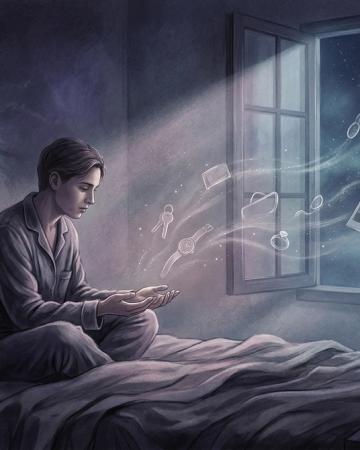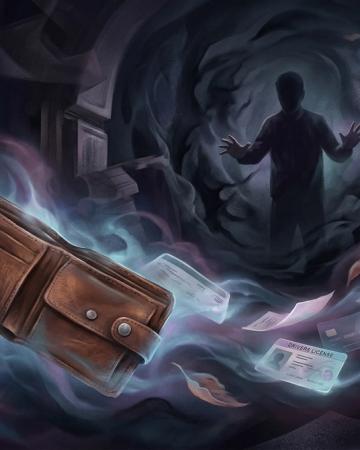


Phone, keys, wallet. You probably know the little ritual: one hand patting your bag before you pull the door shut. Bag dreams play on that reflex. They take away what you thought you had on you, or they hand it back heavier, emptier, or open for everyone to see. The bag matters less than what happens to it. So this page follows the bag from one scene to the next, beginning with a lost purse.
What does a dream about losing your purse mean?
Mostly a worry: that you can no longer prove who you are, or go about your day as usual. Your purse holds your ID, your keys, your money: losing it leaves you without means, all at once.
Picture it: you step off a bus, take three steps, and your hand can't find the strap. What rises up is very specific. You don't think about the bag first; you think about everything you'll have to replace: the driver's license, the house keys, the phone. It often comes during stretches when your place feels shakier: a job that's changing, a relationship where you're no longer sure what you mean to the other person, a move that has thrown off your bearings.
When the dream fixates on your papers ("I lost my purse and my ID"), it often speaks to identity in the broad sense: whatever gives you standing in other people's eyes. When it fixates on the keys, it's more about access: getting home, getting back to a place where you're safe. The key has its own page, and so does losing your wallet, which leans more toward money and the value you give yourself.
Look at the place, too. A bag left at the office, at your parents' house, or on a train doesn't point to the same ground. Where you lose it often shows the part of your life where you feel least sure of yourself right now.
Can losing your bag feel like a relief?
Yes, sometimes, and the way you wake up is what tells you. If you woke up lighter rather than panicked, the dream was probably about a weight you'd like to put down.
Some loss dreams take a strange turn: after the panic, you keep walking empty-handed, and you move faster. That twist can show that part of you is tired of carrying a role, an obligation, an image to keep up. I believe it when the dream shows it clearly. But I won't turn every loss into a liberation: waking up in a cold sweat is still waking up in a cold sweat, and I'm not going to tell you it was good news in disguise. How you reacted in the dream, and then when you woke up, is still your best guide.
What if you find your bag again at the end of the dream?
Losing your bag and then finding it usually means you're going through a real worry, and that your means are holding up better than you thought. The detail that matters most is the state the bag is in when you get it back.
Intact, with everything inside: what you were afraid of losing is holding up, and the dream leaves you on a reassuring note. Open, rifled through, with something missing: ask yourself what in your waking life has been touched without your consent, whether it's a secret repeated, a boundary crossed, or a decision made for you. Writing about tableware, Artemidorus held that a broken dish becoming whole again points to things getting better, and the reverse to things getting worse. The same logic works fairly well for a bag.
Finally, notice who hands it back. A helpful stranger, someone close to you, or you yourself after searching everywhere: each version says who you're counting on for help right now, or who you've stopped counting on.
Why do you search for your bag and never find it?
This one is less about loss than about helplessness: you know the bag exists, it's somewhere, but nothing you do gets it back.
Rooms multiply, hallways stretch out, you go back to the same spot three times. Or the bag is right there on your shoulder, and you're digging through it without finding what you need: the phone that slips through your fingers, the wallet that won't turn up when it's time to pay. Either way, the dream stages a situation where you technically have what you need but can't use it when it counts. I see it as a dream of exhaustion: the tools are there, the energy to look for them isn't. If it keeps coming back, notice exactly what you're looking for in the bag. It's often what you're missing during the day, figuratively: an answer, a quiet moment, someone to lean on. The page on dreams of searching goes further.
What does a stolen bag mean?
A stolen bag is about intrusion: someone, or something, is taking what's yours without asking.
The difference from losing it is clear. When you lose your bag, you blame yourself. When it's stolen, you blame someone else. So the dream asks a different question: who, right now, is encroaching on your time, your space, your private life? A partner signing things in your name, someone close reading your messages, a situation taking more than you want to give. If you saw the thief's face, don't take it too literally: dreams often borrow a familiar face to express a feeling. The page on the thief looks at that figure in detail.
Many readers look this dream up in the Ibn Sirin dream books, which see a bag as a keeper of secrets: a sack slashed open with its contents thrown out means a private life exposed to gossip. Keep that reading in mind if your dream left you feeling ashamed more than angry, as if the cat were out of the bag.
A new purse, a designer bag, a black or brown one: does it change anything?
A purse is also what you show. New or expensive, it often speaks to the image you want to project, or a role you're stepping into.
Getting or buying a new bag tends to come before a change: a new job, a relationship that's starting, a version of yourself you're trying on. A designer bag asks a slightly different question: the gap between the packaging and what's inside. If in the dream you admire the bag without looking at what it holds, ask yourself whether you're spending a lot of energy keeping up a front lately.
As for colors, I stay careful. I know of no old text that gives a fixed meaning to a black bag or a brown one, and I'd rather not make one up. What matters is what that color means to you: a black bag can look sleek and simple to one person, dark and heavy to another. One question often helps: whose bag did it look like? If it was your mother's, a former coworker's, or yours at twenty, the dream is probably about that person, or that time in your life, more than the color.
What about a backpack that's too heavy, or a bag with holes?
A backpack that weighs too much is about what you carry without having chosen it; a bag with holes, about what slips through your fingers despite your efforts.
The American poet Robert Bly, a reader of Jung, gave the bag an image that caught on: each of us drags a long bag behind us, stuffed since childhood with the parts of ourselves our parents, then our teachers, didn't approve of, like anger, bossiness, self-centeredness. We spend our first twenty years filling it, he said, and the rest of our lives trying to get things back out. A backpack crushing your shoulders in a dream may be that bag, emotional baggage in the most literal sense. Before you try to get rid of it, open it: what was inside? Stones, books, things that aren't yours? For suitcases and travel luggage, the page on the suitcase takes over.
The bag with holes is older still. In the Bible, the prophet Haggai describes people who work hard and never get ahead: "he that earneth wages earneth wages to put it into a bag with holes" (Haggai 1:6, KJV). If your bag leaks in the dream, look at what's escaping. Money, hours, strength? The dream often points to an effort that no longer pays back what it costs you.
One last, very concrete step: tonight, empty your actual bag onto the table. Look at what you carry every day without thinking, what you no longer use, what you keep "just in case." Sorting it sometimes leads to the other kind of unpacking: finally getting something off your chest. Then write down your dream with what happened to the bag, what was in it, and how you felt. And if you'd like us to go over it together, that's what the Midnight Mind app is for: your own bag, its color, its weight, where you left it, is where I'd begin.