The Frame of the Image: Between Detachment and Protection
I must confess something to you: as a Baku, I find dreams of television a bit... dry. They lack the organic flavor of wind passing through your skin. Here, everything is filtered by a screen. This is often a sign that your mind is trying to protect you. Sometimes, a truth is too raw, too burning to be experienced from the inside. So, your unconscious projects it onto a screen. You are no longer the one suffering or acting; you are the spectator.
It is a poetic metaphor, in a way: your soul creates its own private cinema to show you pieces of yourself without you burning your wings. But be careful, staying too long in the spectator's chair can become a trap. If, in your dream, you watch your own life unfolding on the screen, ask yourself: why are you afraid to go back "into the movie"? Is it the fear of failing or the fear of feeling too intensely?
There is something melancholy about this distance. It is a bit like a bed where one is a spectator of their own rest; we observe the function rather than living the experience. Television is that glass barrier. It filters information, but it also freezes it.
Static and Zapping: The Quest for Meaning
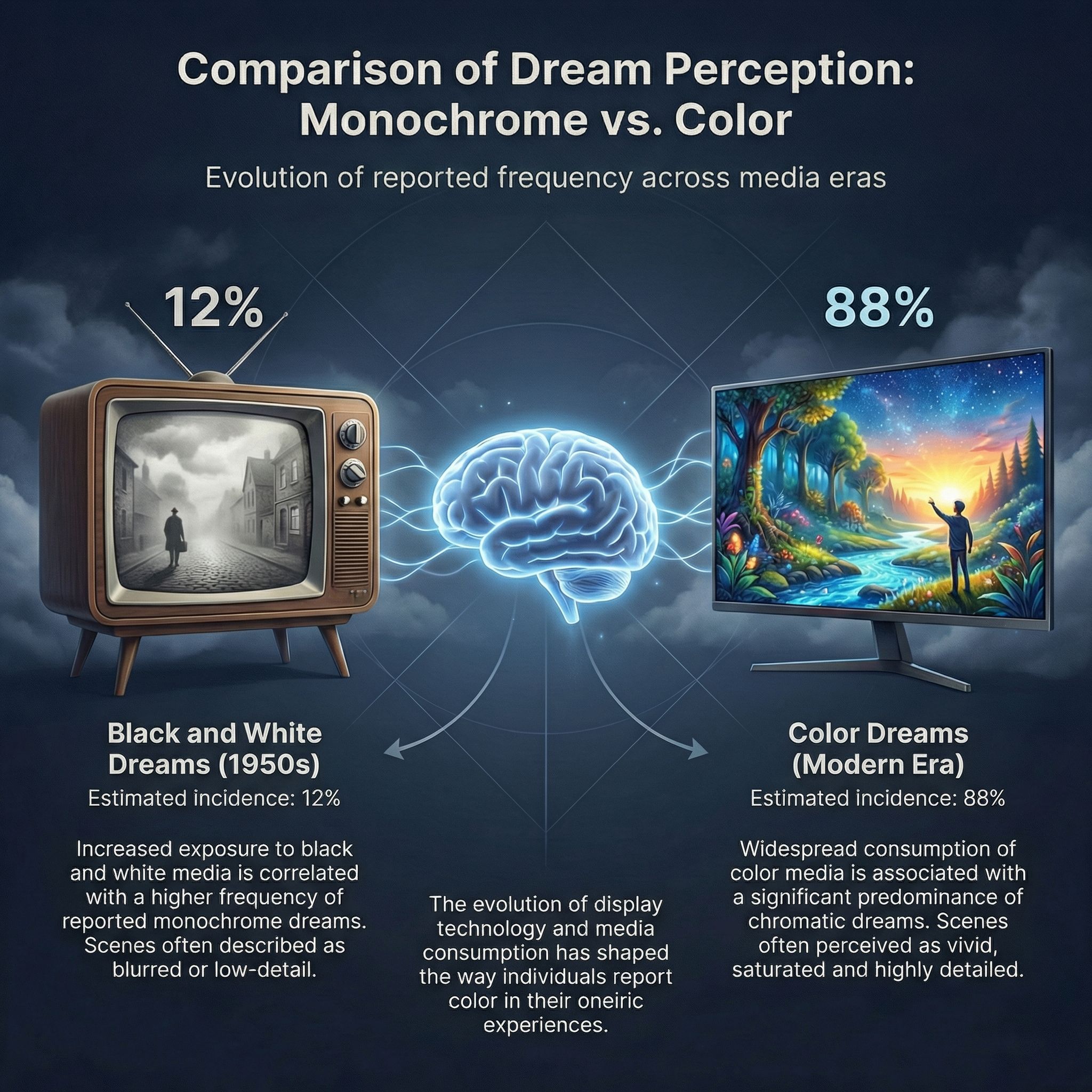
Have you ever felt that frustration in a dream, not being able to find the "right" channel? That black and white crackling, that white noise saturating the space... Honestly, it is one of the most tiring sounds for me to digest. For you, this "noise" is often a sign of mental overload. Too much information, too many external demands, and your internal screen ends up saturated.
If the image is clear, it means the message is ready to be integrated. But if you are zapping frantically, it suggests to me a form of scattering. You are looking for a solution, an answer, but you don't give any image the time to settle. We live in a world that pushes us to consume events like disposable programs. Your dream might be telling you it is time to turn off the device to listen to the silence.
An anecdote comes to mind: a dreamer once told me he was watching a television that only broadcast reflections of his childhood, but with different actors. He was troubled. I told him his mind was trying to rewrite his story to make it more acceptable. Television allows for this staging. It transforms your past into a documentary that you can analyze coldly. It is useful, certainly, but do not forget that life happens on the other side of the glass.
Some dictionaries will tell you that a turned-off television is a bad omen. What nonsense! For me, a black screen is sometimes a blessing. It is the rest of the eye, the end of projected illusions. It is the moment when we stop receiving information and start generating our own light.
What happens when that protective glass suddenly shatters? Sometimes, dreamers tell me they try to touch the television screen, only to feel it splinter under their fingers. It is a terrifying moment, but so incredibly necessary. In psychological terms, this is the sudden collapse of your defenses. You can no longer afford to be a detached observer of your own grief or joy. The boundary between the viewer and the viewed dissolves. If you have experienced this violent transition, it is actually a profound invitation to step back into reality. It is a sudden wake-up call, similar to dreaming of a broken screen, where the illusion of safety is shattered so that you can finally touch the messy, unfiltered texture of your actual life again.
Let’s look at the warmth of that blue light. Historically, humans gathered around a hearth to share myths and keep the night’s shadows at bay. Today, we have replaced that ancestral flame with the cold glow of a television set. If you find yourself sitting alone in a dark room watching a screen in your dream, it speaks of a deep, silent loneliness. Your psyche is trying to recreate a sense of community, a "parasocial" hearth, but it lacks genuine warmth. It is a poor substitute for real connection. I often think of how this artificial blue light contrasts with dreaming of fire, which burns with raw, unpredictable life. The television is a fire that has been tamed, packaged, and stripped of its danger—and consequently, of its power to truly warm your soul.
There is a stranger, more unsettling variation that a dreamer shared with me last autumn. She woke up shivering because, on the television screen in her dream, there was a giant, unblinking eye watching her back. It felt like a surveillance nightmare. Frankly, I find these dreams fascinating because they reveal the quiet tyranny of our own self-judgment. The television becomes the lens of your super-ego, that internalized critic that monitors your every move, judging whether you are playing your "role" correctly. When the screen looks back at you, it is time to ask: whose standards are you trying to meet? Who is the audience you are so desperately trying to please? You are not a performer on a stage; you do not owe anyone a perfect broadcast.
I sometimes wonder how our ancestors would have interpreted this strange glowing box. Before we had screens, our minds projected archetypes onto the stars or into the deep shadows of caves. Now, our unconscious has to use the vocabulary of modern media. If your dream television is playing a generic soap opera or a repetitive news broadcast, your mind is likely playing host to collective anxieties—clichés that do not even belong to you. We absorb so much cultural noise during our waking hours that our dreams have to spend half the night sorting through commercial garbage. Don't mistake these generic, broadcasted fears for your deep, personal truth. Your soul is much more ancient than any network broadcast, and its true language cannot be compressed into digital signals.
If this symbol left you with a feeling of blurriness or nostalgia, perhaps it is time to note exactly what you saw on that screen. Was it a reflection of your desires or a fear put in a box? In the Midnight Mind app, we created a Studio to create comics that could help you pick up the pencils again: instead of watching the movie, you become the author, frame by frame, to better understand the plot your unconscious is trying to weave.
Take care of your nights; they are the only program that truly deserves your attention.