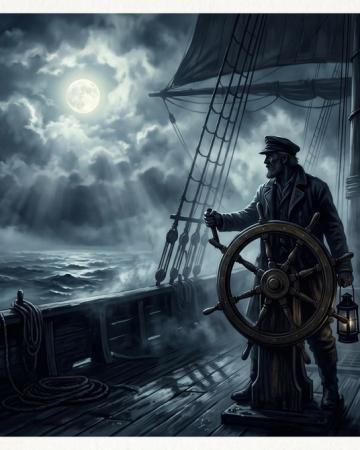
Picture a gangway creaking under your feet, a hull as tall as an apartment building, dozens of people climbing aboard with you and nobody saying where the ship is headed. When you wake up, what often lingers is the sheer size of the thing and the feeling of having traveled with other people. That is what sets a ship apart from a plain boat: it carries a crowd, a chain of command, a cargo, a course set by more than one person. This article reads the dream from there: who is on board, where you stood, and what was holding the ship back or pushing it on.
How is dreaming of a ship different from dreaming of a boat?
A ship is a lived-in place. You are rarely alone on one, and someone else holds part of the course. So the dream is about your place in a larger whole, more than about your own crossing, which the boat tells better.
Artemidorus already held that it is always better to sail on a big vessel with a solid cargo, because small boats leave fear on board even when the crossing goes well (Oneirocritica, book II, chapter 23). Carried over to your dream, an imposing ship often reads as support: a team, a family, an institution that carries you. A big whole also has its inertia, though, and you don't steer it alone. Ask yourself which group in your life this vessel matches, and whether you chose it or simply found yourself aboard.
The cargo matters too. If you see crates, containers or sacks piled on deck, ask what your group is carrying right now: a shared project, things nobody says out loud, habits nobody has sorted through. A well-secured load points to a group that holds its course. A crowded deck that leans to one side points to a weight everyone carries without mentioning it.
The state of the ocean around the ship adds the mood of that group: dead calm, swell, fog. A ship on glassy water may describe a stretch when everything holds together; a rising swell, a tension the group is working through. In my view, that is the first detail to write down, even before the size of the ship.
Where were you on board, and what does that place say?
Your place on board tells you the role you play in the group. As a passenger, you let yourself be carried; as a deckhand, you do the work; at the helm, you decide; in the hold, you put up with it.
- On deck, watching the horizon. You are in a phase of trust or contemplation. Ask yourself whether you know the destination or simply agreed to step aboard.
- In the hold. You work without seeing the sky: a task, a role or a relationship where you are asked to keep the machine running and never told the route.
- At the helm. Responsibility rests on you. If you don't know the route in the dream, check whether you were handed a seat you never asked for, and too quickly. The captain has an article of its own for that role.
- In your cabin with the door shut. You belong to the voyage while keeping it at arm's length, which can be a rest or a withdrawal.
Artemidorus pushed the correspondence a long way for people dreaming at sea: the mast stands for the captain, the prow for the helmsman, the rigging for the sailors. Damage to one of those parts pointed, he thought, to the man it matched. I wouldn't go that far, but the idea has some use: notice which part of the ship drew your eye, and who in your life it makes you think of.
Readings that make the ship a simple sign of success strike me as too short. You can feel alone among a thousand passengers, or be held on board by a ticket you never chose.
What does it mean when the ship won't move, whether docked or run aground?
A motionless ship raises one question: who or what is holding it? A wait you chose, or a constraint that won't name itself.
Texts credited to Ibn Sirin read a ship that floats without moving as imprisonment. Artemidorus sees obstacles in business in not being able to sail despite wanting to. Both see a hindrance first in the stillness. I would add one nuance: a ship moored in a port and being loaded with crates and supplies can also be a preparation, even if the waiting weighs on you.
To decide, look at what holds it. Artemidorus separates the anchor, which reassures but keeps you from leaving, from the mooring lines thrown ashore, which he links with debts and commitments. Carried over: an anchor is a support you cling to, a mooring line a promise someone still holds. A ship aground on a sandbar asks for something else: a pause you haven't allowed yourself. If you want to set out again, ask which line only you can untie.
What about a captain who is missing, or who is everywhere?
The captain often stands for the person or the rule that decides for the group. A missing captain points to a gap in direction; one who is everywhere, to an authority you haven't finished sizing up.
In the texts that go under Ibn Sirin's name, the crew stands for servants, the sail for the captain, and the condition of the ship for the dreamer's condition in life. Use that last point to inspect the hull: peeling paint, clean sails, an engine that coughs. It tells you something about the health of the whole you belong to.
If no one is at the wheel, don't rush to ask who should be. Ask whether you have been staying back, waiting for someone to take care of it. And if a captain gives orders you don't agree with, note what you feel: anger, relief, a wish to take over? That reaction is worth more than the captain's face.
What does it mean to watch a ship leave or come back from the dock?
From the shore, the ship is no longer your vehicle. It becomes something that happens to you or slips away from you, a departure or a return.
Artemidorus reads ships putting out to sea as good things that will arrive more slowly, since the voyage is only beginning, and ships coming back into harbor as good things that speed up. Seeing ships sail well from the shore, he adds, announces journeys abroad, the return of those who are away, sometimes news from overseas. Those same texts say that watching a ship at sea from the shore means glad tidings.
I rarely read this dream literally. Ask yourself instead what departure or return you are waiting for: a person, a decision, a piece of news. If you stay on the dock while the ship pulls away, look at what you are leaving behind. If the ship is coming home, what is coming back to you after a long detour? Sometimes the dream simply goes along with a real trip.
What if the ship is taking on water, or going down?
When water rises in the hold, the useful question becomes: what are you doing, and what are the others doing?
The full reading of a wreck is in the article on shipwreck dreams. Here, the group angle is what counts. Are you the only one bailing while everyone else dances on deck? Do you call for help? Do you leave the ship at the first alarm, or last? A ship taking on water often shows a team, a couple or a family leaking somewhere without anyone saying so. Your reaction in the dream shows your place in that leak. Notice also whether the water rises slowly or all at once: it tells you whether the trouble has been building for a while or has just surfaced.
How can you use this dream when you wake up?
Treat the ship like a floor plan: its size, its condition, the sea, your place, the people on board, and what was holding it back or helping it along. Five lines are enough, written before the coffee wipes them out. Then write next to it the name of the real group the vessel most resembles.
One last step: pick a detail of the ship that stayed with you (a bell, a hold, a sail) and ask yourself when this week you ran into it again. If you want to see what your dream holds besides the ship, Yume can read it in the app with all its details: the crew, the state of the sea, the place you occupied.