The inner court: when the soul demands an accounting
I often find, while tasting the smoke of those who sleep, the metallic bitterness of guilt. This is the primary spice of courtroom dreams. But be careful, I am not necessarily talking about a real fault, the kind punished in the physical world. No, the world of dreams is much more subtle than that.
When you dream of a court of law, you are not facing the law of men, but your own law. It is a magnifying mirror. Sometimes, it tires me a bit to see simplistic interpretations saying that a judgment in a dream predicts a loss of money or a neighborhood dispute. It’s so... dry. The psyche is a wild garden, not a ledger. If you find yourself on the stand, it’s because your subconscious feels it is time to "rule" on something you have let linger.
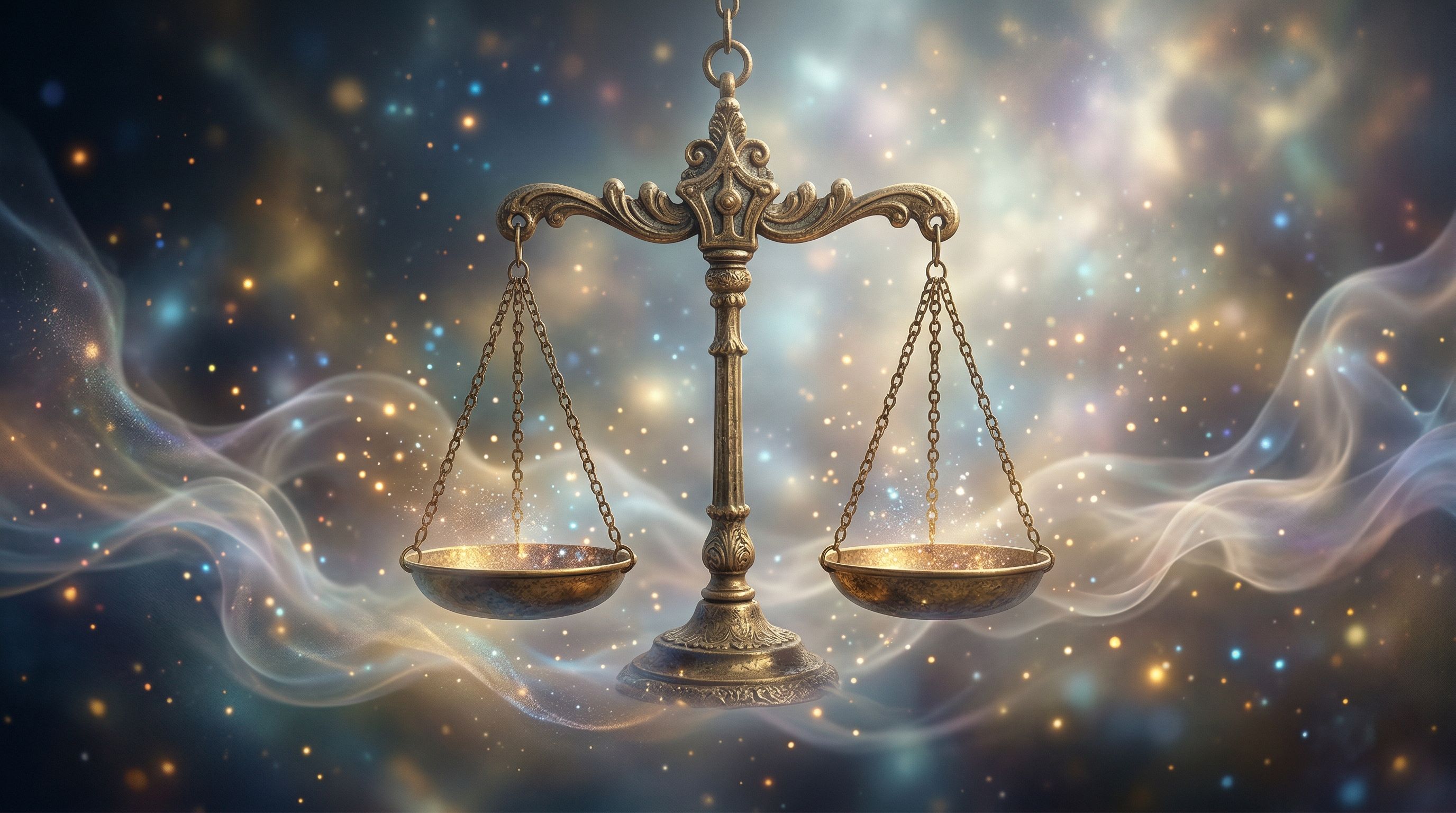
This symbol has fascinated me for millennia because it shows our human capacity to split in two: the one who acts and the one who observes. If the setting is intimidating, perhaps you are giving too much power to your inner judge. Is he fair? Or is he a tyrant? Sometimes, it is useful to ask if you aren't manipulating this scale with a cheating finger, being much harsher on yourself than you would be on a friend. The courtroom dream is an invitation to observe the evidence, not just the charges.
The roles we play: defendant, witness, or judge?
In this nocturnal theater, your role is crucial. If you are the defendant, you probably feel social pressure or a fear of being "found out." This is the classic dream of those suffering from imposter syndrome. We wait for the verdict with the fear that it will confirm what we dread: "You are not good enough." But that is a lie of the dream! The verdict is never a final condemnation; it is information.
I once encountered a dreamer who, every night, saw himself as a mere witness in a massive trial. He said nothing; he just watched. In talking with him, we realized that in his life, he was running away from his responsibilities, remaining a spectator of his own existence when he was being asked to take a stand. The court was there to remind him that silence is also a choice.
The setting itself matters. A modern, cold, and sterile courtroom often evokes emotional disconnection. An old wooden courtroom, dark and solemn, touches on more ancestral roots, education, or family lineage. Sometimes, time seems frozen, much like observing a pendulum that refuses to swing, signifying that you are stuck waiting for external permission to move forward. Sincerely, I find it sad when a dreamer waits for an imaginary judge to give them the right to be happy. The key to the cell has often remained in the defendant's pocket.
The verdict: a liberation rather than a sentence
Many people wake up before the judge pronounces the sentence. It’s frustrating, isn’t it? You’re left with that suspense in your gut. Yet, this void is an opportunity. If the dream stops before the verdict, it means the decision still belongs to you in reality. Your subconscious shows you the staging, but it leaves you the pen to write the conclusion.
If the verdict comes down and it is "guilty," do not panic. In the language of the Bakus, "guilty" often means "responsible." The dream is telling you: "Yes, this belongs to you; take ownership of this part of your story so you can transform it." If you are acquitted, it is an immense wave of relief, a reconciliation with your shadow sides.
I am not a fan of dictionaries that give a single fixed meaning. Every courtroom is unique because every dreamer has their own definition of justice. For some, it is a matter of morality; for others, it is a matter of life balance. What is certain is that this dream is not a threat. It is a necessary tidying session. We sort through what is true and what is projection. We place unnecessary burdens on the clerk's desk and leave feeling lighter.
Remember: in the court of your mind, you are simultaneously the law code, the lawyer, and the sovereign. The purpose of this dream is not to punish you, but to restore your sovereignty. The next time you see that gavel rise, do not bow your head. Look the judge in the eye, and you might see that he has your own face, but with a gaze a bit more tired from always having to decide everything.
Sometimes, the courtroom isn't about moral guilt, but the heavy air of expectations you’ve outgrown. I often taste a stale, dusty paper flavor in the dreams of those who are preparing to quit a life that no longer fits them. You sit there, the collar of your shirt too tight, the mahogany walls pressing in, feeling like an impostor simply because you want something different. It is a very specific weight, closely tied to how we handle authority. It reminds me of the paralyzing anxiety of being summoned by a demanding boss, where you are pre-emptively preparing your defense for the crime of wanting to be free. The courtroom manifests when you feel you must justify your desire for change to a jury that only exists in your mind.
I sometimes wonder why our modern minds choose such cold, bureaucratic structures for self-evaluation. Ancient dreamers, centuries ago, did not dream of fluorescent-lit courtrooms; they envisioned scales weighing their hearts against the feather of Ma'at, the Egyptian goddess of truth. There was a sacred, quiet beauty to it—a quest for cosmic balance, not punishment. Now, we build sterile benches and hire phantom lawyers to argue our worth in the dark. Why do we subject ourselves to such dry, administrative torture? Sincèrement, this shift fascinates and saddens me. We have traded the poetic search for harmony for a system of pure self-flagellation. If your dream-court feels like an endless, grey bureaucracy, perhaps you’ve forgotten how to measure your soul with lightness. You are not a file to be processed; you are a living being seeking balance.
What if you aren't the one on trial, but the one pacing the floor, pleading a case? I once met a dreamer who spent her nights desperately defending a silent, shadowy figure in the dock. She woke up exhausted, her throat dry from arguing. It turned out the silent defendant was her own creativity, which she had locked away years ago to pursue a "sensible" career. She was acting as the defense attorney for her own suppressed soul, pleading with her imposing judge for a little bit of mercy. It is a strange paradox: we play all the parts. Honestly, even for me, these split-identity dreams remain beautifully mysterious. They show that even when we lock our truest selves away, some part of us is still willing to stand up and fight for our release in the dead of night.
If you need to keep track of these faces encountered in the courtroom or precisely note the words of the verdict before they evaporate like morning mist, you can use Midnight Mind to document these encounters and perhaps even turn this trial into a comic strip where, this time, you decide the outcome.
Which evidence weighs heaviest on your heart today? Come deposit them in your collection of symbols and let’s see together if we cannot transform this courtroom into a space of peace.