The Mapping of the Soul: When Your Mind Seeks Its Way
If there is one thing that has fascinated me since I began wandering through the world of sleep, it is the sheer variety of these "maps." Some dreamers tell me of ancient, yellowed parchments that smell of dust and mystery. Others see GPS screens that flicker but cannot find a signal.
This variety of symbols says so much about how you perceive your own trajectory. A map in a dream is never just a simple geographic representation; it is a metaphor for your mental structure.
If the map you see is clear and detailed, you likely feel ready to face a new challenge. You may already have the steps of your project laid out in your mind. However, I invite you to be careful with rigid interpretations.
A map that is too precise can also reflect an excessive need for control. It might be a sign that you are afraid of leaving room for the unexpected. Sometimes, your subconscious shows you a perfect map just to whisper: "Look how hard you are trying to freeze everything, when life is really a flowing river."
🌙 The echo of Yume : A map is a promise, not a prison. It shows you where you could go, not where you must stay.
Conversely, if you dream that you are holding a map but it is desperately blank, do not panic. This isn't a threat or a bad omen. It is your mind humbly acknowledging that it is in a phase of transition.
When your usual landmarks disappear, your brain must create new connections. An unreadable map is the permission you give yourself to be, for a time, an explorer without a fixed destination. It is a state of pure potential.
---
Tracing Your Path: Between Exploration and Intuition
I remember a dreamer who once told me they found a map where the names of the cities were replaced by emotions: "Anger," "Immense Joy," "Melancholy." That is the true magic of dream cartography.
The path you are trying to trace isn't necessarily made of asphalt or dirt trails. When you dream of exploration, ask yourself: what territory are you seeking to conquer? Is it a new career path, a relationship, or a deeper understanding of your own shadows?
If you see yourself studying the map intently, it means you are in an active phase of your life. You are no longer just a passenger. You are becoming the architect of your own journey.
Sometimes, you might find yourself looking for a map in strange places, much like a supermarket, where the abundance of choices can feel overwhelming. In both cases, your mind is trying to categorize and navigate through a sea of options.
I often feel a gentle tug of frustration when I hear people say that losing your map is a bad sign. In the world of dreams, true exploration often begins where the marked paths end.
Losing the map forces you to look up from the paper and actually see the landscape around you. If you feel lost, try to remember the atmosphere: was it an oppressive anxiety, or a kind of wild freedom?
Concrete Example: The Shifting Border
Imagine you are holding a map of your childhood home, but the rooms keep moving. You try to find the exit, but the hallway leads to a forest. This "unstable map" often occurs when you are undergoing a deep personality shift. Your internal "GPS" is recalibrating because the person you were no longer fits the environment you are moving into. Instead of fighting the shift, try to observe the new landscape with curiosity.
---
The Science of the Inner Compass
While the mystical side of maps is beautiful, some specialists in sleep science suggest a more functional perspective. They estimate that dreaming of navigation is a way for the brain to practice spatial memory and problem-solving.
When you "map" in your sleep, your hippocampus—the part of the brain dedicated to memory—is often hard at work. It processes the events of the day and files them into your long-term internal archive.
This doesn't strip the dream of its magic. Rather, it shows how deeply your survival and your self-growth are linked. Your mind wants you to be prepared for the terrain of tomorrow.
Whether you are navigating a complex social situation or dealing with something as sharp and unexpected as a sea urchin, your dreams act as a rehearsal space.
The symbol of the map remains mysterious because it evolves alongside you. It can be a wing, light as a feather, if it opens the doors to a future you didn't dare imagine.
My advice, little dreamer, is not to try and "solve" your map dream like a math equation. Instead, look at the shadows—those "terra incognita" where you haven't yet dared to set foot.
That is often where the most beautiful treasures of your subconscious are hidden. The map is not the territory; it is simply the invitation you send to yourself to begin the adventure.
If you want to explore your dreams more deeply, your Baku is waiting for you. You might find that keeping a record of these landscapes helps you see how your inner world changes over time. It is a beautiful way to become your own cartographer.
I once met a dreamer who was desperately trying to swallow a wet, pulpy paper map in her sleep. It sounds bizarre, almost comical, but her unconscious was screaming a deep truth: she didn't want to follow the directions anymore, she wanted to embody them. We often treat maps as external tools, forgetting the tactile weight they carry in our sleep. Is the parchment dry and crumbling in your hands, or are you desperately folding it until the corners tear? When you feel the physical struggle of handling paper in a dream, it is often a sign of friction between your rational plans and your visceral reality. You might think you need a detailed itinerary, but your soul is actually begging you to trust your own stride, even if you feel you are traveling without the comfort of worn shoes to protect you.
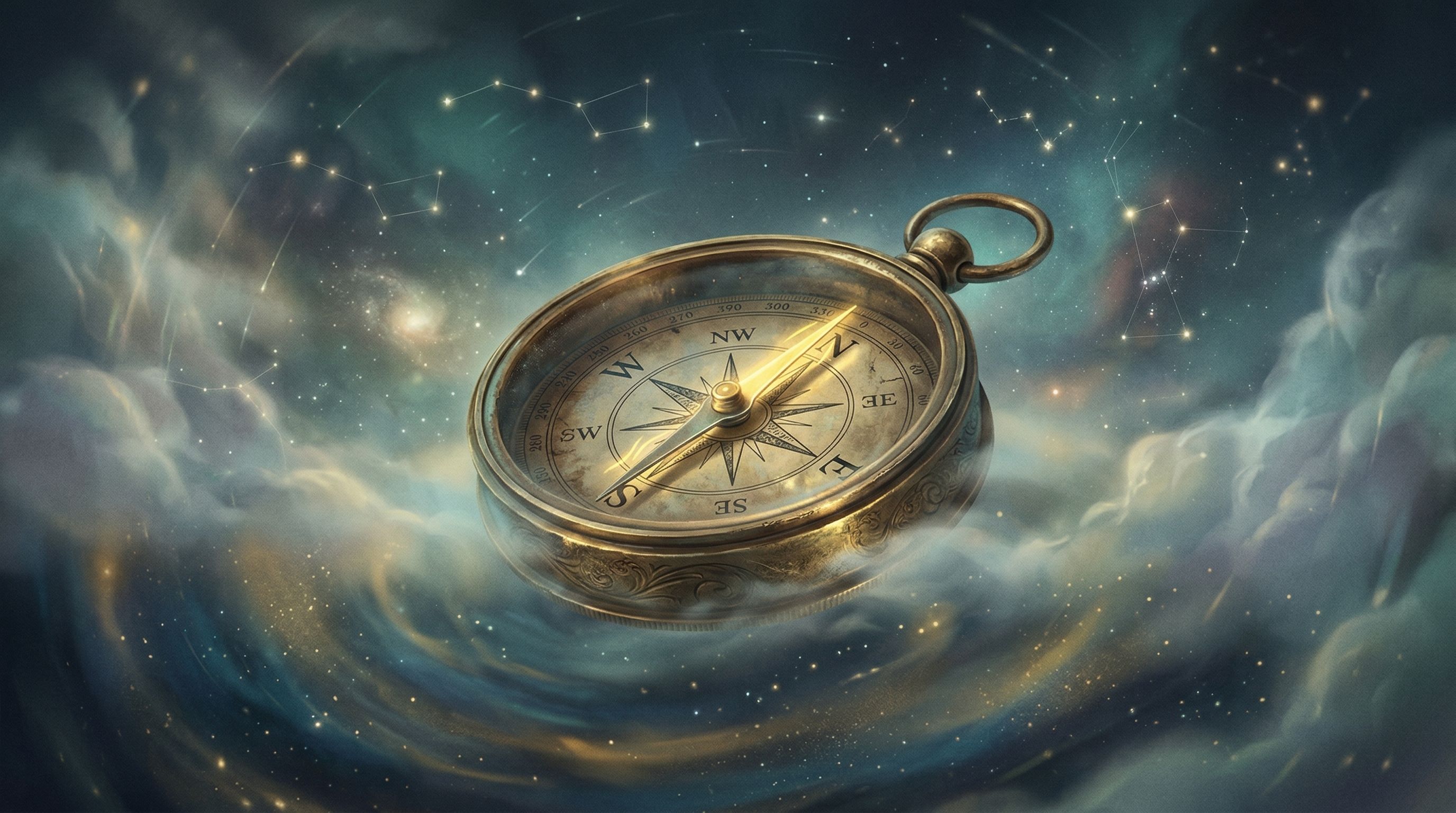
Sometimes, the map we hold doesn't look at the earth at all, but turns its gaze upward. I find it deeply beautiful when dreamers describe star charts instead of roads, navigating by constellations that don't exist in our waking sky. Ancient maritime cultures didn't use lines on paper; they read the sea and the stars as a living, shifting grid. If your dream map looks more like a cosmic atlas or the glowing swirls of the Milky Way, it is an invitation to zoom out. Your immediate, everyday worries—that career choice, that domestic tension—are being reframed against a much larger canvas. Your mind is trying to align you with a natural rhythm, reminding you that even in the darkest, most trackless night, there is a quiet celestial order guiding your steps.
There is a quiet, melancholic variation of this dream that I see far too often: searching a map for a house that no longer exists, or looking for a loved one who has passed away. It is incredibly painful to wake up from these searches. Yet, this is how your heart processes the architecture of absence. Grief rearranges our internal geography; it leaves a massive, unmapped void where a person or a life phase used to be. If you find yourself tracing lines in search of what is gone, please be gentle with yourself. Your mind isn't torturing you; it is trying to redraw the boundaries of your world now that the landscape has fundamentally changed. You are learning to navigate a territory where the old landmarks have vanished, drafting a new map one quiet breath at a time.